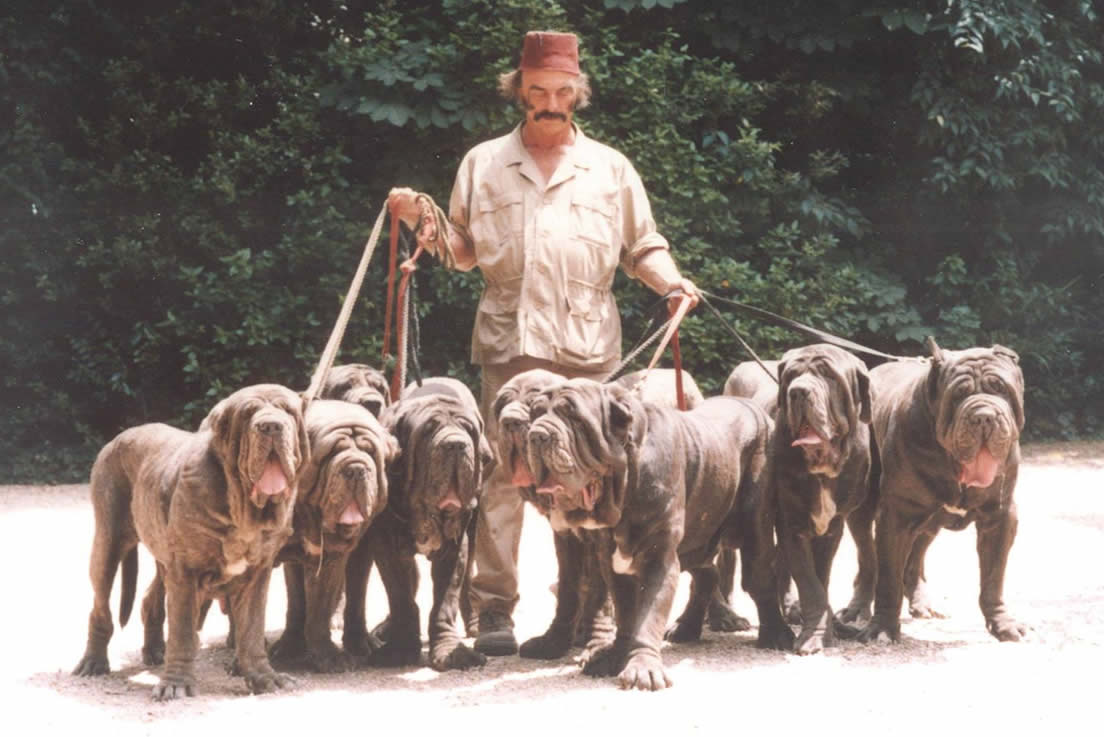
CANE CORSO and NEAPOLITAN MASTIFF The truth beyond the myths
For decades, stories about the Cane Corso and the Neapolitan Mastiff have been told with epic tones, tales, and legends. Some say they are direct descendants of the Roman Canis Pugnax, others imagine them as arena warriors, relics of a distant empire.
Dr. Vito Branco, DVM, is a veterinarian in Italy. He writes on topics related to the history and reality of dogs in Roman antiquity, combining ancient literary sources and archaeological evidence. His work focuses on clarifying myths and emphasizing practical uses and functions of dogs rather than romanticized legends.
Education
Information about his formal education beyond the DVM degree (Doctor of Veterinary Medicine) is not publicly available.
But the truth is something else, and it is no less fascinating: it is more concrete, more real, closer to our land. It is the truth of the fields, of the farms, of the stables, of sweat and blood.
Until the mid-20th century, in Southern Italy there were no standardized breeds. There were the can’ e presa: rustic dogs, shaped by work, chosen for their usefulness and not for appearance. They guarded homes and stables, defended crops and haystacks, drove and protected livestock, and faced wild boar and other wildlife. They differed from one another, but were united by the same function: to be indispensable. Many had cropped ears and tails, not for vanity but for necessity. From that practical gesture came the word “corz,” meaning shortened, which over time became “Corso.”
From this common stock, two identities split off. The Neapolitan Mastiff, called “cane ’e presa,” was the most imposing and wrinkled, solemn, implacable, a living monument to power. Since 1949, with official recognition, selective breeding crystallized it into a unique dog, a statue of flesh unlike any other in the world. The Cane Corso, on the other hand, remained the dog of the farmer, shepherd, and hunter: leaner, rustic, agile, capable of many functions. It was not a pure and continuous breed, but a functional type, molded to the purposes and needs of different regions: Puglia, Basilicata, Calabria, Sicily, inland Campania. Only in the 1970s and 1980s was an attempt made to reconstruct it, and inevitably other breeds such as the Boxer, Bullmastiff, and even the Mastiff itself contributed to fixing its lines.
The historical facts speak clearly: no proof directly connects the Corso and the Mastiff to the Canis Pugnax. They are the children of recent rural civilization, not of the Roman arena. Even tail docking and ear cropping, often demonized or romanticized, arose from practical needs: in the Corso to reduce risks during hunting and fights, in the Mastiff to prevent fractures and maintain balance. Only with show-dog cynophilia did these cuts become style, until the law prohibited them.
The Cane Corso has never been an unbroken pure breed: it is the product of targeted crossbreeding and practical selection, and as a true breed was only born in the 1980s. The Neapolitan Mastiff, on the other hand, is the fruit of precise, consolidated, and officially recognized selection since 1949, and it conquered the world with its uniqueness and grandeur. Unfortunately, since the 2000s it has suffered from trends that demanded extreme exaggeration, betraying the dog and contaminating it with blood from Great Danes, Mastiffs, and Saint Bernards.
They are not enemies. They are not duplicates. They are brothers of the same stock, children of the same presa dog, more likely related to the Spanish perro de presa, but developed in two opposite directions: the Mastiff, monumental, solemn, and implacable; the Corso, agile, versatile, and rustic.
So enough with legends. Enough with comforting tales.
The Cane Corso is not the Canis Pugnax.
The Neapolitan Mastiff is not a Roman warrior.
They are much more: they are faithful witnesses of a peasant civilization that survived through the strength of its dogs.
Recognizing this truth does not diminish them. It finally frees them from lies. The Mastiff is a unique work of selection, the Corso is the modern witness of an ancient functionality. Both deserve respect, not for what is invented about them, but for what they really were and still are today.
Those who truly love them must have the courage to face reality: because their greatness needs no myths. It lies entirely in the truth.
Dr. Vito Branco, DVM
Veterinarian – Scholar of Italian molossoids
CANE CORSO e MASTINO NAPOLETANO La verità oltre i miti
Da decenni si racconta del Cane Corso e del Mastino Napoletano con toni epici, favole e leggende. C’è chi li vuole discendenti diretti dal Canis Pugnax dei Romani, chi li immagina guerrieri d’arena, reliquie di un impero lontano. Ma la verità è un’altra, e non è meno affascinante: è più concreta, più vera, più vicina alla nostra terra. È la verità dei campi, delle masserie, delle stalle, del sudore e del sangue.
Fino a metà Novecento, nel Meridione d’Italia non esistevano razze codificate. Esistevano i can’ e presa: cani rustici, forgiati dal lavoro, scelti per la loro utilità e non per l’apparenza. Custodivano case e stalle, difendevano raccolti e pagliai, conducevano e proteggevano il bestiame, affrontavano il cinghiale e qualsiasi altro selvatico. Erano diversi l’uno dall’altro, ma uniti dalla stessa funzione: essere indispensabili. Molti portavano orecchie e coda accorciate, non per vanità ma per necessità. Da quel gesto pratico nacque la parola “corz”, accorciato, che nel tempo divenne “Corso”.
Da quel ceppo comune si staccarono due anime. Il Mastino Napoletano, chiamato “cane ’e presa”, era il più imponente e rugoso, solenne, implacabile, monumento vivente alla potenza. Dal 1949, con il riconoscimento ufficiale, la selezione lo cristallizzò in un cane unico, una statua di carne che non assomiglia a nessun altro al mondo. Il Cane Corso, invece, rimase il cane del contadino, del pastore e del cacciatore: più asciutto, rustico, agile, capace di mille funzioni. Non era una razza pura e continua, ma un tipo funzionale, modellato sugli scopi e sulle esigenze delle diverse regioni: Puglia, Basilicata, Calabria, Sicilia, Campania interna. Solo negli anni Settanta e Ottanta si tentò di ricostruirlo, e fu inevitabile l’apporto di altre razze come Boxer, Bullmastiff e lo stesso Mastino, per fissarne le linee.
Le verità storiche parlano chiaro: nessuna prova collega direttamente Corso e Mastino al Canis Pugnax. Sono figli della civiltà rurale recente, non dell’arena romana. Anche la caudotomia e la conchectomia, spesso demonizzate o romanticizzate, nacquero da esigenze pratiche: nel Corso per ridurre i rischi durante caccia e combattimenti, nel Mastino per prevenire fratture e mantenere equilibrio. Solo con la cinofilia da esposizione quei tagli divennero stile, fino a quando la legge li ha vietati.
Il Cane Corso non è mai stato una razza pura ininterrotta: è il prodotto di incroci mirati e selezione pratica, e come razza vera e propria è nato solo negli anni Ottanta. Il Mastino Napoletano, invece, è il frutto di una selezione precisa, consolidata e riconosciuta già nel 1949, e ha conquistato il mondo con la sua unicità e imponenza. Peccato per la deriva che ha vissuto dal 2000 in poi, quando l’ossessione per l’ipertipo richiesto dalle mode ha tradito il cane, sporcandolo con sangue di Alani, Mastiff e San Bernardo.
Non sono nemici. Non sono doppioni. Sono fratelli dello stesso ceppo, figli dello stesso cane da presa, più probabilmente imparentato con i perro de presa spagnoli, ma cresciuti in due direzioni opposte: il Mastino, monumentale, solenne e implacabile; il Corso, agile, versatile e rustico.
E allora basta leggende. Basta favole consolatorie.
Il Cane Corso non è il Canis Pugnax.
Il Mastino Napoletano non è un guerriero romano.
Sono molto di più: sono testimoni fedeli di una civiltà contadina che resisteva con la forza dei suoi cani.
Riconoscere questa verità non li sminuisce. Li rende finalmente liberi dalle bugie. Il Mastino è un’opera unica di selezione, il Corso è il testimone moderno di un’antica funzionalità. Entrambi meritano rispetto, non per ciò che si inventa su di loro, ma per ciò che davvero sono stati e sono ancora oggi.
Chi li ama davvero deve avere il coraggio di guardare in faccia la realtà: perché la loro grandezza non ha bisogno di miti. Sta tutta nella verità.